
The Risen Christ: A Thought for Today

For April 5, 2026
Easter stands at the center of the Christian faith—the moment when sorrow gave way to joy, when death was conquered, and when the hope of eternal life was secured through the resurrection of Jesus Christ (1 Corinthians 15:3–4, 54–57).

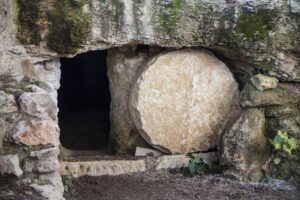
In the early morning hours, while the world was still shrouded in darkness, the first witnesses came to the tomb expecting to mourn their beloved Teacher (John 20:1). Instead, they encountered an empty grave and the inconceivable message:
He is not here; He is risen!
(Luke 24:6; Matthew 28:6)

Fear, confusion, and wonder filled their hearts as the reality of the risen Lord began to unfold.

From that moment forward, everything changed. The risen Christ revealed Himself to His followers—not as a distant memory, but as the living God and Savior (John 20:14–16, 19–20). He called them by name, walked with them, taught them, and opened their understanding. Their doubt was transformed into faith, their fear into boldness, and their despair into unshakable hope (Luke 24:27, 32, 45; John 20:19–21, 27–28).

This same risen King now calls us to live in the light of His victory.

Because Easter is not merely a celebrated day to remember, but a truth to embrace—a living reality that shapes how we think, live, and believe. Because He lives, we are no longer bound by sin, defined by our past, or without hope for the future.

As we reflect on the empty tomb, we are reminded that we serve a Savior who keeps His promises. The One who rose from the grave has also promised to return (Acts 1:9–11).

Thus, we live as a people set apart—watching, waiting, and preparing our hearts as we anticipate the glorious appearing of our Lord and King. Especially in light of the unrest in the Middle East.

Jesus is coming again, and very soon!

While reading Leviticus 20:26: “You shall be holy to Me, for I, the LORD, am holy, and have separated you from the peoples to be Mine,” I was reminded of our Lord’s command in Matthew 5:48: “Be perfect, therefore, as your heavenly Father is perfect.”

Some challenge the idea of Christian holy living by pointing to examples of moral failure, while others excuse themselves by saying, “Nobody’s perfect.”  Those who reject the call to holiness fail to realize that it is our eternal God and risen Savior who commands us—whether we choose to accept His authority or not.

When someone says, “I’m not a pedophile, a rapist, a murderer, or a drug dealer—so I’m not a bad person,”  it reveals a flawed way of thinking about sin. it usually suggests that somehow sin is measured on a “sliding scale,” and that “our good deeds outweigh our bad deeds.” But Scripture teaches that sin isn’t graded on a curve. Sin separates us from God, and no amount of good works can outweigh it.

It also leans on the false notion that our good deeds can somehow outweigh or cancel out our failures. But, this reasoning collapses in the face of Jesus Christ, our perfect and holy standard.

Our righteousness, compared to His, is utterly void—even on our best day. We have a sin problem that yields a sobering reality: apart from Christ, we face eternal separation from God.

Yet God, in His great love, has made a way. Through His Spirit, He draws us to humbly and sincerely seek the only remedy—grace through faith in Jesus Christ.

“But God, who is rich in mercy, because of His great love with which He loved us, even when we were dead in trespasses, made us alive together with Christ (by grace you have been saved), and raised us up together, and made us sit together in the heavenly places in Christ Jesus, that in the ages to come He might show the exceeding riches of His grace in His kindness toward us in Christ Jesus.”    (Ephesians 2:4–7)

His Spirit within us creates a growing desire for His mercy and sustaining power, enabling us to live for Christ daily. This new, Spirit-led life flows from genuine faith in Christ alone. It transforms us from the inside out and makes us acceptable to God despite our human weakness.

In His perfection, God also provides every spiritual resource we need to be conformed to the image of Christ. As the Apostle John reminds us, when we see Him in glory, “we shall be like Him.” (Romans 8:29; 1 John 3:2).

What an incredible privilege and responsibility we have. Not only do we bear the name of Christ as Christians, but we also reveal Him to others through our thoughts, words, and actions.

Jesus lives today—and His people can share His amazing love and righteousness  with the world!

As we prepare for Easter and look beyond, let us remember that we are called to be God’s holy people—set apart for Him and destined to share eternity in His presence. May we faithfully reflect the life of our Lord and Savior, Jesus Christ, to a world in need, as we watch, wait, and prepare for His promised return.

May this Easter also serve to renew our faith, strengthen our witness, and deepen our longing for the day when we will see Him face to face. Won’t you receive Him today?

What a Wonderful Savior!

An Eventful Week

For April 3, 2026
On Sunday, during the Triumphal Entry, crowds filled the streets of Jerusalem, heralding Jesus Christ as Messiah. (Matthew 21:9) By Monday, the Lord had cleansed the Temple of those accursed vendors. (Matthew 21:12) On Tuesday, He silenced disputes concerning His authority and taught openly about His Kingdom. (Matthew 21:23-27) Later, a woman—identified in John’s Gospel as Mary—anointed Him with costly oil. (John 12:3) In the midst of mounting tension, He quietly arranged for a furnished room to observe the Passover.

Now it was Thursday evening of Passover week and the Disciples longed for a break, a pause to celebrate God’s past deliverance. The Passover Seder was meant to be a joyful, familiar gathering in what would later be called the Upper Room. (Luke 22:12)

But from the outset, something was different….

After settling a dispute over Kingdom greatness (Luke 22:24-27), Jesus did the unthinkable—He washed their feet. (John 13:4-5) Then He then foretold their coming desertion, Peter’s denial (and restoration), and revealed that one among them would betray Him. (Matthew 26:31-35, Luke 22:31-34) Judas departs into the night. (John 13:30)

What should have been a peaceful observance was now a gathering heavy with tension. And then, something even more extraordinary happened. Instead of following the traditional Seder liturgy, Jesus took the bread, blessed it, broke it, and gave it to the Eleven, saying,

“Take, eat; this is My body.”
(Matthew 26:26, Mark 14:22)

Then He took the cup, gave thanks, and said,

“Drink from it, all of you. For this is My blood of the new covenant, which is shed for many for the remission of sins… Do this in remembrance of Me.”     (Matthew 26:27-28, Luke 22:20

The familiar had become prophetic.

As they sang a hymn and followed Him toward the Mount of Olives, one can only imagine the questions racing through their minds: Why did He change the Seder? What did He mean—His body? His blood? Within hours, they would begin to understand.

What makes this moment even more profound is that Jesus was not walking blindly into suffering. He knew exactly what lay ahead—and Scripture had already foretold it.

Psalm 22 gives us a window into the suffering of the Messiah—a passage written almost a thousand years before His birth, yet vividly describing the crucifixion.

“My God, My God, why have You forsaken Me?”
(Psalm 22:1)

These are the very words Jesus would cry from the cross. Psalm 22 continues with uncanny precision:

      • Mockery from onlookers, scorn from the crowd—“He trusts in the Lord; let Him rescue Him.” (Psalm 22:7-8)
      • His hands and feet are pierced. (Psalm 22:16)
      • His bones are exposed. (Psalm 22:17)
      • His garments are divided, and lots are cast. (Psalm 22:18)

This is not coincidence. This is divine revelation. Even before the cross, the suffering of Christ was written—so that when it came to pass, we would recognize the Savior. And yet, Psalm 22 does not end in despair. It rises to triumph:

“All the ends of the world shall remember and turn to the Lord.”
(Psalm 22:27)

The Suffering Servant shall become the Victorious King! What was Jesus thinking as He broke that bread and shared the cup?  Scripture gives us the answer:

“You see, at just the right time, when we were still powerless, Christ died for the ungodly… But God demonstrates His own love for us in this: while we were still sinners, Christ died for us”    (Romans 5:6–8).

From the first Adam came sin, corruption, and death. God created us for holiness and eternal fellowship, yet through disobedience, sin entered the world—and with it, separation from God.

We all bear that stain. Like a white garment ruined by a single stain, our righteousness is polluted by sin. No matter how good we appear, our best efforts fall short before a holy God. As Scripture says:

“All our righteous acts are like filthy rags.”
(Isaiah 64:6)

What we could never accomplish, Christ fulfilled perfectly. He lived without sin. He went to the cross willingly. And through His sacrifice, He made a way to restore what was lost:

“For God so loved the world that He gave His only begotten Son, that whoever believes in Him should not perish but have everlasting life. For God did not send His Son into the world to condemn the world, but that the world through Him might be saved.”   (John 3:16-17)

This is the glory of the Gospel. Jesus did not merely die for the worthy, the righteous, or the deserving. He died for the ungodly—for rebels, for sinners, for enemies of God. He died for all of us, and this is where the message becomes personal.

It is not difficult to imagine sacrificing for someone we love. But to lay down one’s life for those who reject, mock, or hate us—that is beyond human comprehension or instinct.

Yet this is what Christ did for each of us.

In a world increasingly marked by indifference to human dignity—where the unborn, the elderly, and the vulnerable are often discarded—His sacrifice stands in stark contrast. Humanity may assign value based on convenience or cost, but God has declared the worth of every life through the cross. We have reduced life to transactions. Christ redeemed it with His blood.

No longer are we bound by sin, Satan, and death. Through faith in Jesus Christ, His finished work becomes our righteousness. The cross is not merely an event—it is the dividing line of eternity.

And Psalm 22 reminds us: suffering was not the end of the story. Victory was always in the forefront and would be realized in just three days:

“Looking unto Jesus, the author and finisher of our faith, who for the joy that was set before Him endured the cross, despising the shame, and has sat down at the right hand of the throne of God.”     (Hebrews 12:2)

Won’t you trust Christ today and experience His great love and forgiveness personally?

What a Wonderful Savior!

Hosanna In The Highest!

For March 29, 2026
Every year, Christians around the world remember a moment that and changed history forever—Palm Sunday.

It began in Jerusalem, a city already overflowing with pilgrims. The streets were crowded, the air electric with expectation, as travelers from around the world gathered to commemorate the Exodus—when God miraculously delivered His people from Egyptian bondage.

Enormous crowds had descended upon the city because this was one of the three designated times when all Jewish males were obligated to assemble before the Lord “in a place which the Lord shall choose” (Deuteronomy 16:16).

Then it happened.

On Sunday, while people were preparing for the Passover, there was widespread commotion. The level of excitement and anticipation grew as the commotion became an audible chant, which then accelerated into a deafening roar:

“Hosanna to the Son of David! Blessed is He who comes in the name of the Lord! Hosanna in the Highest!”    (Matthew 21:9).

It was apparent that royalty had come to town.

Today, chauffeured limousines with identifying insignia provide ground transportation for nobility. Two thousand years ago, conquering rulers rode horses to symbolize their power and dominance over their vanquished subjects. Inexplicably, humbly, and meekly, our Lord rode on a colt—the foal of a donkey—and thereby fulfilled the prophecy in Zechariah 9:9:

“Rejoice greatly, O daughter of Zion; shout, O daughter of Jerusalem: behold, thy King cometh unto thee: He is just, and having salvation; lowly, and riding upon an ass, and upon a colt the foal of an ass!”

On His Triumphal Entry into Jerusalem, our Lord chose a mode of transportation that would present Him as the “Prince of Peace,” also depicted in Isaiah 9:6. As a result, throngs of people covered the road with clothes or palm branches, while swelling crowds cheered and waved palm branches in celebration (Matthew 21:8).

Jesus Christ had arrived in His earthly splendor, and “the whole world had gone after Him!” (John 12:19).

It is remarkable that our eternal and holy God chose to occupy human flesh as Jesus Christ. Even more astounding is that although He was Creator and Sustainer, He used this humble form of transportation on the first day of what would become the last and most important week of His earthly life.

He could have chosen something more suitable to His station as King of Kings and Lord of Lords. (In other words, why did He fly “standby” when He had a first-class ticket?)

But on second thought, the Lord’s choice is not so surprising given His earlier teachings:

“Come unto me, all ye that labour and are heavy laden, and I will give you rest. Take my yoke upon you, and learn of me; for I am meek and lowly in heart: and ye shall find rest unto your souls. For my yoke is easy, and my burden is light!”  (Matthew 11:28–30)

Truly, our Lord established a new paradigm featuring genuine humility, unrivaled meekness, and matchless love. He had every right to be the Conquering King, but He chose to be the Humble Servant instead.

And although death awaited Him, He subjected Himself to insulting, demeaning, and humiliating crowds because He loves us more than we could ever conceive.

The King Is Coming Again

Palm Sunday was not only the arrival of a King—it was also a preview of something far greater yet to come.

The first time Jesus Christ entered Jerusalem, He came in humility, riding on a donkey as God’s Suffering Servant. He came to bear the sins of the world and offer salvation to all who would believe.

But Scripture declares that this will not be His final entrance. One day He will return again—not in quiet humility, but in unmistakable glory:

“Then the sign of the Son of Man will appear in heaven, and then all the tribes of the earth will mourn, and they will see the Son of Man coming on the clouds of heaven with power and great glory.”  (Matthew 24:30)

The One who once rode into Jerusalem as the Prince of Peace will return as the Righteous King and Judge of all the earth.

What Palm Sunday foreshadowed, the future will fully reveal. The question is not if the King will come again. The question is whether we will be ready to receive Him.

More than two thousand years ago, travelers from distant lands came searching for the Messiah. The Gospel tells us that wise men once followed a star until they found Him. And the truth still remains—wise men and women still seek Him today:

      • We seek Him in the Scriptures.
      • We seek Him in prayer.
      • We seek Him by faith.

Those who seek Him will discover that the King who once entered Jerusalem is still approachable, still merciful, and still calling people to Himself.

Behold, I stand at the door and knock. If anyone hears My voice and opens the door, I will come in to him and dine with him, and he with Me.” (Revelation 3:20)

Palm branches may no longer line the roads of Jerusalem or our city streets, yet the invitation remains open. The King who came once is coming again. And when He comes, there will be no mistaking it: every crown will fall before Him, every knee will bow, and every tongue will confess that Jesus Christ is Lord.

So the question Palm Sunday leaves with us is simple:

      • Will we greet Him as our Savior today—or will we face Him as our Righteous Judge tomorrow?

Wise men and women seek and follow Him. Because the greatest decision any of us will ever make is whether we will welcome Christ Jesus as our Lord and Savior before He returns. Won’t you surrender to Him today and allow Him to change your life forever?

The King is coming, and He is still approachable and accessible to us today by faith.

What a Wonderful Savior!

Happy New Year!

For January 1, 2026
A wide range of emotions surrounds the New Year. As the clock strikes midnight, many celebrate with joy and anticipation. For these individuals, a new year feels full of promise. But others carry sorrow, regret, or uncertainty into the days ahead. For them, the turning of the calendar is a reminder of what was lost or left unfinished.

The New Year is more than a change in dates—it is an invitation to turn our hearts toward the One who makes all things new. Each passing year reminds us of this extraordinary truth: history itself is centered on one Person—Jesus Christ. The Scriptures declare:

And He is before all things, and in Him all things consist.
Colossians 1:17 (NKJV)

Our calendar reflects this reality. The Gregorian Calendar, adopted in 1582 to correct the drift of the earlier Julian Calendar, numbers each year from the birth of Jesus Christ.

The designation B.C. marks the time before His birth, while the years since are known as Anno Domini (A.D.), meaning “in the year of our Lord.” Today this is also called the Common Era (C.E.), but regardless of the name, the reference point remains the same—Jesus Christ stands at the center of human history.

As we enter 2026, we acknowledge that more than two thousand years have passed since the birth of Jesus (though many scholars place His actual birth around 4 B.C.). No other human figure has shaped the world so profoundly. No other life has transformed so many hearts, and no other name provides what every human soul urgently needs: forgiveness, peace, purpose, and eternal life.

Only Jesus Christ can reconcile a sinful humanity to a holy God. We cannot fix ourselves, erase our guilt, or earn God’s favor through good intentions and moral effort. But God, in His mercy, has done for us what we could never do for ourselves.

      • Jesus perfectly obeyed God’s Law for us, something we couldn’t do ourselves.
      • By dying on the cross, he made the ultimate sacrifice, suffering the penalty we deserved for our sins.
      • His resurrection showed a complete victory over sin and death.
      • Upon His ascension to heaven, He intercedes on our behalf and promises a glorious return.

Salvation is not achieved by our works—it is received by our faith in His works. When we turn from trusting ourselves and place our trust in Jesus Christ alone, God forgives us, makes us new creatures, and gives us eternal life.

Here is what the Word of God declares:

But God, who is rich in mercy, because of His great love with which He loved us, even when we were dead in trespasses, made us alive together with Christ (by grace you have been saved), and raised us up together, and made us sit together in the heavenly places in Christ Jesus, that in the ages to come He might show the exceeding riches of His grace in His kindness toward us in Christ Jesus. For by grace you have been saved through faith, and that not of yourselves; it is the gift of God, not of works, lest anyone should boast. For we are His workmanship, created in Christ Jesus for good works, which God prepared beforehand that we should walk in them.    Ephesians 2:4—10 (NKJV)

Jesus extends this invitation to every weary heart:

Come to Me, all you who labor and are heavy laden, and I will give you rest.      Matthew 11:28 (NKJV)

The year 2025 was hard for many. Perhaps you were disappointed by others. Or your plans fell apart. Maybe you feel tired, empty, or uncertain about the future. If so, hear this clearly: Jesus Christ is not finished with you.

      • People may disappoint, but He will not.
      • You can weaken, but His strength is eternal.
      • The past can trouble you, but His grace is greater than your past.

This new year can be more than a change on the calendar. It can mark the dawn of a new life where the Lord will never abandon or forsake you.

I am with you always, even to the end of the age.
Matthew 28:20b (NKJV)

If you will turn to Jesus Christ, by repenting of your sin and trusting Him fully, He promises forgiveness, freedom, purpose, and a joy that no power on earth can steal, and He guarantees an eternal life of peace with God.

When our New Year’s resolutions begin not with self-effort but with surrender to Christ, God does a work in us that no resolution ever could. Only then can we truly experience a very Happy New Year.

Jesus Christ is calling you today. Won’t you give Him your heart and experience new life forever?

What a Wonderful Savior!                                                                   

Giving Thanks to the Lord on this Thanksgiving

For November 27, 2025
Thanksgiving is more than a holiday—it’s a declaration of the heart. We give thanks as we join generations of believers who have experienced the goodness, blessings, and faithfulness of our loving, amazing God. Gratitude is our testimony, as we—the redeemed of the Lord—say so.

The Word of God encourages us to give thanks unto Him:

 In everything give thanks; for this is the will of God in Christ Jesus concerning you.     1 Thessalonians 5:18 (AKJV)

Here are four reasons we can give thanks to our Lord:

We Can Give Thanks for His Majesty and Splendor
The majesty of God fills the heavens and the earth. His glory is displayed in every sunrise, every heartbeat, and every moment of beauty that reflects His power. As we give thanks, we stand in awe of His glory and splendor, proclaiming—as did King David in Psalm 8:1 (NKJV):

O LORD, our Lord, How excellent is Your name in all the earth,  Who have set Your glory above the heavens!

It is impossible to describe God as we would inanimate objects or created beings. The Scriptures tell us that in Him we “live and move and have our being.” (Acts 17:28) Although we only “know in part” (1 Corinthians 13:9), every question finds its answer in Him and every problem its solution.

His incomparable majesty and splendor are beyond human comprehension. Yet, in His grace, He chooses to reveal Himself to us through the person of Jesus Christ, so that we can truly know Him and experience His perfect plan for our lives.

We Can Give Thanks for His Sovereignty and Almighty Power
Even when life feels uncertain, God’s sovereignty gives us peace. He reigns with wisdom and love, guiding every moment according to His perfect plan. To give thanks in all things is to trust that His hand is at work—shaping our stories for His glory and our good, as Romans 8:28 (NKJV) affirms:

And we know that all things work together for good to those who love God, to those who are the called according to His purpose.

God is limitless in power, knowledge, and presence. He is present everywhere at all times, and His omnipresence fills heaven and earth without diminishing His essence. He exists beyond all we can comprehend, as the psalmist declares:

Great is our Lord, and mighty in power; His understanding is infinite.             Psalm 147:5 (NKJV)

God’s power is absolute to do anything He wills, and His will is always aligned with His perfect nature. He is the self-existent origin of all life—the Living God, the Creator, Sustainer, and Sovereign Ruler of heaven and earth.

It is comforting to know that in the face of an uncertain and chaotic world, the Lord is in control and has promised to be with His precious children until the end:

 I am with you always, even to the end of the age. Amen.
Matthew 28:20 (NKJV)

We Can Give Thanks for His Holiness and Righteousness
God is morally and spiritually perfect in all aspects. Holiness is self-affirming purity and the very essence of His being. God alone maintains moral excellence because only He is pure, majestic, glorious, and without equal:

Who is like You, O LORD, among the gods?  Who is like You, glorious in holiness, Fearful in praises, doing wonders?   Exodus 15:11 (NKJV)

God embodies truth and faithfulness as the very standard of moral integrity. His judgments are just, His promises unshakable, and His unwavering character inspires our unwavering trust:

The works of His hands are verity and justice;  All His precepts are sure. They stand fast forever and ever, And are done in truth and uprightness. He has sent redemption to His people; He has commanded His covenant forever: Holy and awesome is His name.    Psalm 111:7–9 (NKJV)

Yet, God’s holiness and righteousness do not preclude His intervention in human lives. In His perfection, He has chosen to dwell among us in the person of Jesus Christ. His perfection doesn’t distance us—it redeems us. This Thanksgiving, we thank God that the Holy One welcomes us into His presence through grace:

For by grace you have been saved through faith, and that not of yourselves; it is the gift of God, not of works, lest anyone should boast. For we are His workmanship, created in Christ Jesus for good works, which God prepared beforehand that we should walk in them.    Ephesians 2:8–10 (NKJV)

We Can Give Thanks for His Mercy and Lovingkindness
In this modern age of defiant sin and selfish entitlement, we deserve God’s wrath—death! But thank God for His mercy and lovingkindness.

For all have sinned and fall short of the glory of God. Romans 3:23  (NKJV)

For the wages of sin is death, but the gift of God is eternal life in Christ Jesus our Lord.   Romans 6:23 (NKJV)

God’s willingness to forego judgment and apply mercy is motivated by His great love for us. This eternal, deliberate, selfless, and sacrificial plan for our benefit lies at the core of His love. Although He continually reveals His heart through countless expressions of benevolence each day, His greatest demonstration was in the giving of His Son to forgive our sin and restore our fellowship forever:

For God so loved the world that He gave His only begotten Son, that whoever believes in Him should not perish but have everlasting life. For God did not send His Son into the world to condemn the world, but that the world through Him might be saved.   John 3:16–17 (NKJV)

He who does not love does not know God, for God is love . . . In this is love, not that we loved God, but that He loved us and sent His Son to be the propitiation for our sins.     1 John 4:8, 10 (NKJV)

God’s mercy is new every morning (Lamentations 3:22–23). It meets us in our failures and restores us with forgiveness. We who have tasted His mercy are truly thankful and blessed.

This Thanksgiving, may we thank Him for His majesty that inspires awe, His sovereignty that brings peace, His holiness that transforms, and His mercy that endures forever.

Oh, give thanks to the LORD, for He is good! For His mercy endures forever. Let the redeemed of the LORD say so.   Psalm 107:1–2 (NKJV)

Won’t you trust the Lord today and experience His grace and mercy?

Happy Thanksgiving!

What a Wonderful Savior!

Photo by Kiy Turk

Top